The Independence Prior of SAEs Fragments Visual Concepts
Abstract
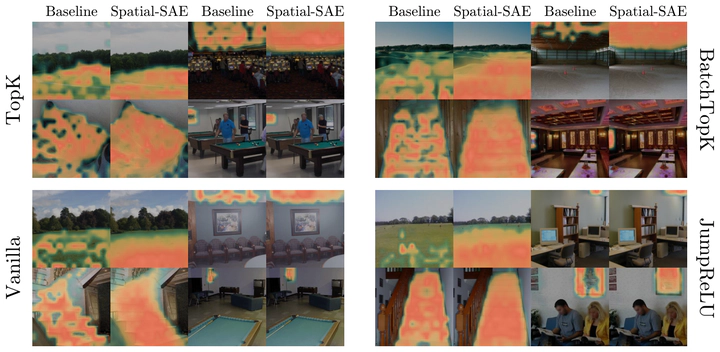
Sparse Autoencoders (SAEs) decompose model activations into sparse combinations of interpretable dictionary atoms. Although SAEs are grounded in the Linear Representation Hypothesis (LRH), their objective smuggles in an additional prior: concepts across patches are treated as independent, an assumption clearly violated by natural images and by the activations they induce. We therefore specialize LRH to vision through the Markov-Field Linear Representation Hypothesis (MFLRH), which adds the missing spatial dependencies to the LRH assumptions. We thus propose Spatial-SAE as an amortized MAP estimator under the MFLRH. Spatial-SAE consistently outperforms standard SAEs in concept recovery and interpretability. Across four variants, it achieves a 96% average win rate on synthetic concept recovery and improves interpretability on DINOv2 activations, at a reconstruction cost concentrated in high spatial frequencies.

Donato Crisostomi
AI Safety Fellow @ Anthropic
My research interests revolve around artificial intelligence, in particular model merging and representational alignment.